
Your RAG system is in production and failing in specific, repeatable ways. Before selecting a new types of rag architecture or rebuilding the pipeline, the right starting point is a failure mode diagnosis identifying which specific retrieval failure your system is producing. The four architecture types covered here Standard, Adaptive, Corrective, and Audit-Ready RAG each resolve a different failure class.
Most teams select architecture before they have production failure data. This guide inverts that sequence: diagnose the failure mode your query log reveals, select the architecture layer that resolves it, and plan the upgrade additively.
Each architecture type in this guide adds a specific layer to the previous one. Upgrading from Standard to Corrective RAG does not require a rebuild it adds a validation step on top of the existing retrieval step. Understanding what each layer adds, and what it costs, makes the upgrade decision operational rather than theoretical.
Failure Mode 1: Irrelevant Retrieval on a Homogeneous Corpus - Standard RAG Diagnosis
Standard RAG is appropriate for low-stakes retrieval against a single domain index with well-formed queries and no compliance requirements. Regulated industries and private AI deployment requirements explains why regulated industries need more than the standard pipeline.
When the primary failure mode is irrelevant chunks returned on a single-domain corpus, the first diagnostic is Standard RAG configuration not an architecture upgrade. Classify the last 50 failed queries by failure type. If the primary failure is irrelevant chunks caused by chunk size mismatch or embedding model underfit, re-chunking and embedding model tuning resolves the issue without adding architectural complexity. Standard RAG architecture is not the problem; Standard RAG configuration is.
Standard RAG remains the right architecture when: the document corpus is single-domain, queries are single-hop, there is no compliance requirement for source citation, and query volume is high enough that orchestration overhead would meaningfully degrade latency. Only upgrade the architecture after confirming that configuration tuning does not resolve the primary failure mode.
Failure Mode 2: One Retrieval Strategy Fails Diverse Query Types - Adaptive RAG Upgrade
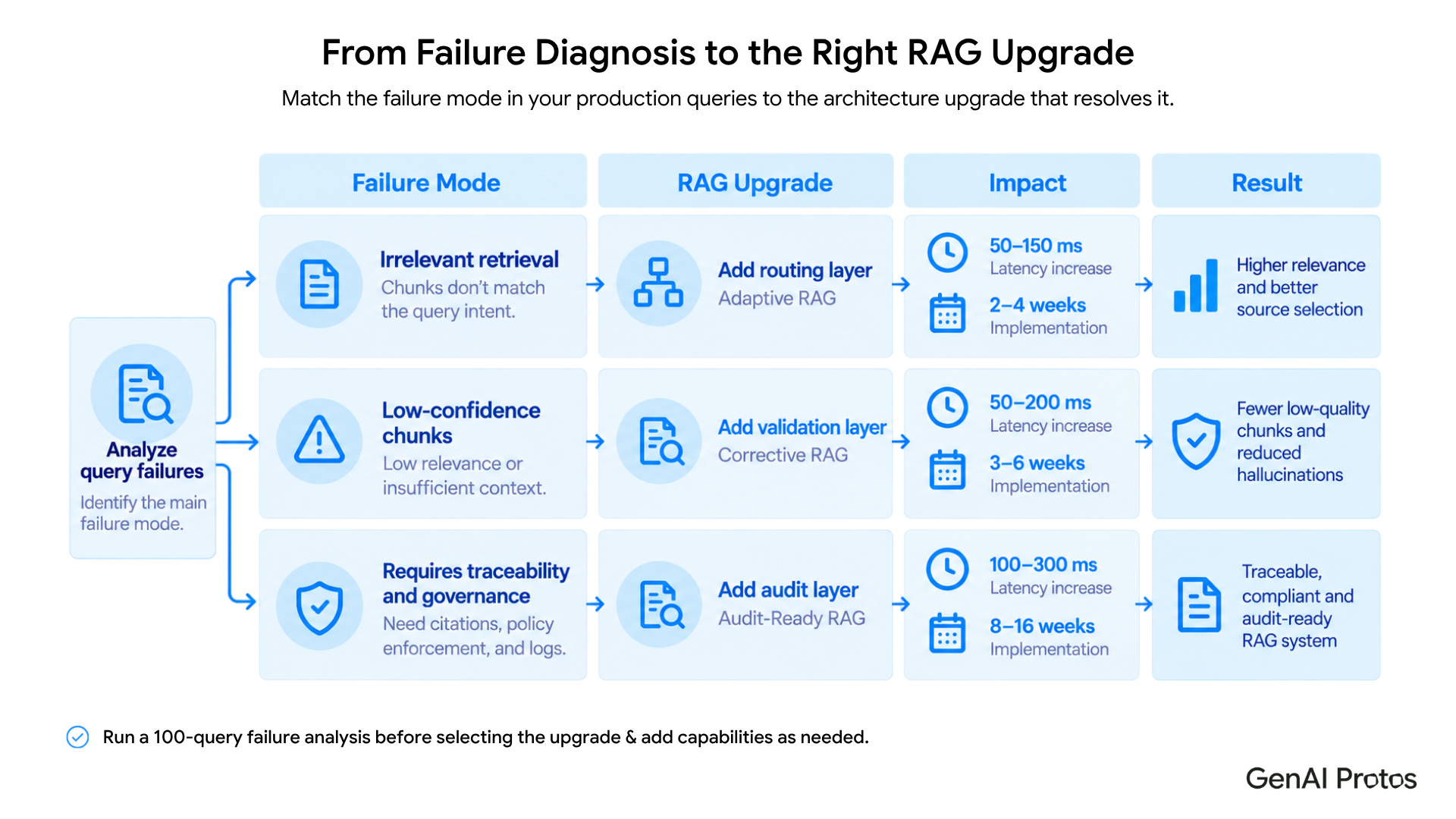
Adaptive RAG resolves the failure mode where different query types need different retrieval strategies. If factual lookups need sparse retrieval while analytical questions need dense search, and Standard RAG applies one strategy to both, adding a routing layer is the right upgrade.
Adaptive RAG upgrade: adds a query classifier at entry that routes to appropriate retrieval strategy. Cost: 50-150ms latency overhead per query. No index rebuild required. Timeline: 2-4 weeks.
Failure Mode 3: Hallucination from Low-Confidence Retrieved Chunks - Corrective RAG Upgrade
Corrective RAG resolves the failure mode where retrieved chunks pass the similarity threshold but are not actually relevant to the query, causing the LLM to generate claims from poor-quality context. The validation loop evaluates retrieved chunks against a relevance confidence threshold before they reach the synthesis layer. Chunks that fall below threshold are dropped. When no chunk clears the threshold, the system triggers a fallback: a secondary index query, a web search, or a no-answer response.
The Corrective RAG research (see Corrective RAG paper by Shi et al. 2024) established that retrieval validation before synthesis significantly reduces hallucination from low-confidence retrieval. The key mechanism: when aggregate confidence is below the defined threshold, the pipeline retries with an alternative strategy rather than passing insufficient context to the LLM.
What the Corrective RAG upgrade adds: a relevance scoring step after retrieval, before synthesis. Cost: one scoring call per retrieved chunk. For top-10 retrieval, that is 10 scoring calls per query (typically 50-200ms overhead depending on the scoring model). Timeline: 3-6 weeks including threshold calibration against your actual document corpus. Upgrade decision: if the hallucination failure mode traces to low-relevance retrieved chunks not an insufficient corpus Corrective RAG resolves it.
Audit-Ready RAG: The Compliance Architecture
Audit-Ready RAG adds three layers to the standard pipeline: source citation mapping, the Deterministic Air-Gap Policy Layer, and retrieval log persistence. Compliance AI assistant: how to build it right covers the full compliance architecture for regulated AI deployments.
Source citation mapping requires every chunk in the synthesis context to carry a source identifier document ID, chunk position, and retrieval timestamp and requires the synthesis layer to map every output claim to the specific chunk that supports it. This is what makes the output traceable during an audit.
The Deterministic Air-Gap Policy Layer sits between retrieval and synthesis. It evaluates retrieved chunks against explicit, rule-based policy conditions not model-generated decisions. A retrieved chunk that violates a defined policy rule is dropped before synthesis. Because the policy rules are deterministic, their decisions are reproducible and auditable by compliance teams without requiring model explainability.
Retrieval log persistence captures every retrieval event with enough detail to reconstruct the pipeline behavior during an audit: query, retrieved chunks with source identifiers, validation scores, policy decisions, and synthesis output. The log must be immutable and retained for the compliance-required period.
What the Audit-Ready RAG upgrade adds to a Corrective RAG pipeline: source citation mapping at the synthesis layer, the Deterministic Air-Gap Policy Layer, and retrieval log persistence. Cost: significant logging infrastructure, policy rule authoring and maintenance, and source citation verification add pipeline complexity and operational overhead. Timeline: 8-16 weeks including policy authoring, compliance review, and testing under audit conditions. Upgrade decision: only when regulatory, contractual, or internal governance requirements mandate traceable source attribution.
Planning the Upgrade: Cost and Complexity at Each Step
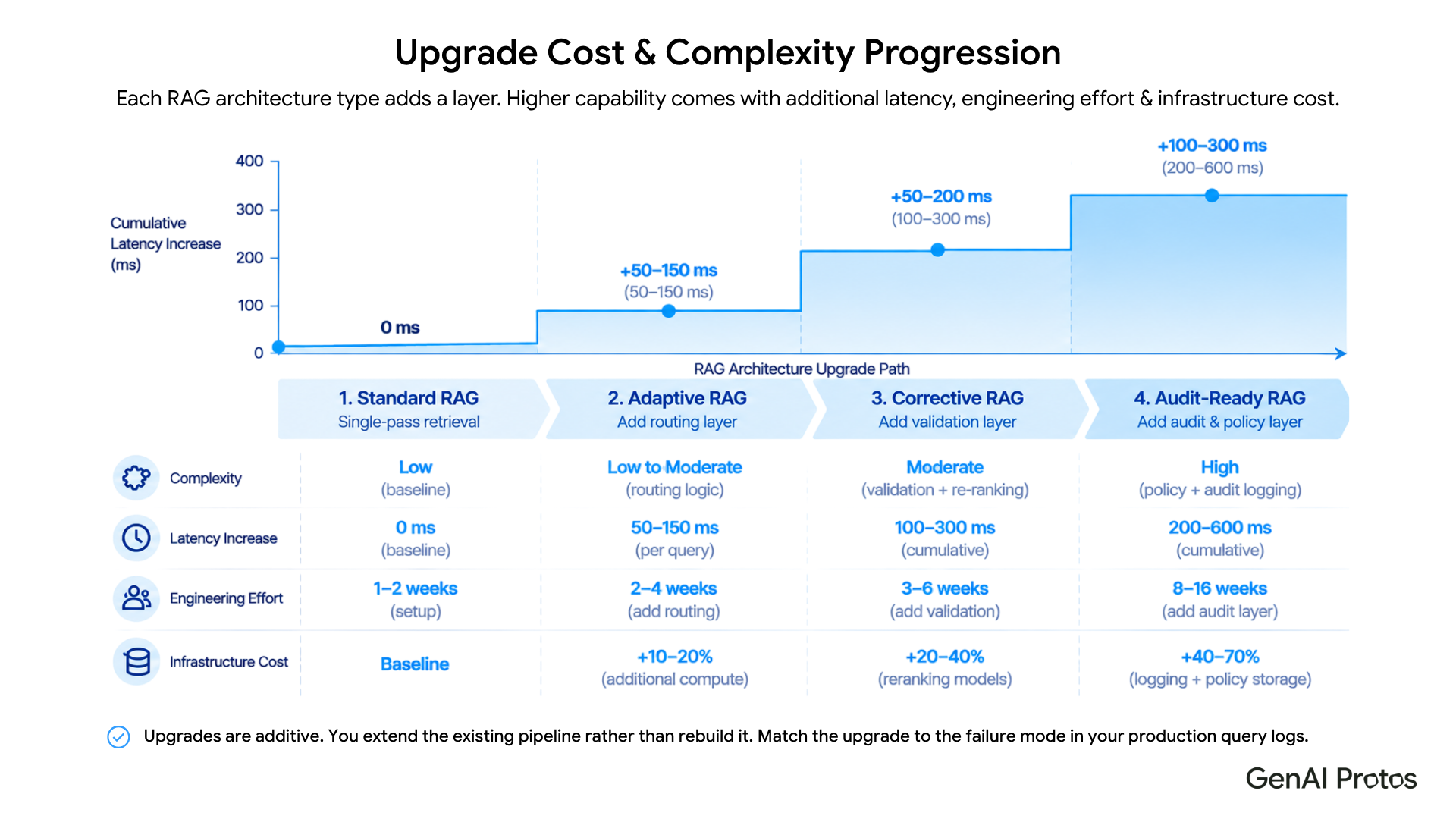
Standard to Adaptive: Add query classifier. Complexity is low. Latency: 50-150ms per query. Timeline: 2-4 weeks.
Adaptive to Corrective: Add chunk relevance scorer after retrieval. Complexity is moderate. Latency: 50-200ms per query. Timeline: 3-6 weeks.
Corrective to Audit-Ready: Add source citation mapping, Deterministic Air-Gap Policy Layer, and retrieval log persistence. Complexity is high. Latency: 100-300ms additional. Timeline: 8-16 weeks.
Each upgrade is additive. A team running Corrective RAG adds the Deterministic Air-Gap Policy Layer and logging infrastructure on top of the existing validation loop it does not rebuild the pipeline from scratch.
Match the upgrade to the failure mode your production query log reveals. A team solving an irrelevant-chunk problem does not need Audit-Ready RAG. A team under active regulatory audit requirements cannot stop at Corrective RAG.
The practical starting point is a 100-query failure mode analysis. Classify each failed query by failure type: irrelevant retrieval, low-confidence chunks, hallucinated claims, or untraceability. The dominant failure class determines the upgrade target. Run the analysis before planning the architecture change.
Design an Audit-Ready RAG Architecture for Your Regulated Environment
GenAI Protos builds production RAG systems for regulated industries with Deterministic Air-Gap Policy Layers, source citation pipelines, and compliance-ready audit logging. Book a design session to assess your current retrieval architecture.
Contact UsMigration Checklist: What to Verify at Each Architecture Upgrade
Advanced RAG design for enterprise retrieval applications covers the design considerations. Migration from Standard to Audit-Ready RAG is a structural extension, not a replacement. The existing retrieval and synthesis components remain in place. You add the Policy Layer between them, add metadata tagging to all ingested chunks, add the citation mapper post-synthesis, and add the retrieval log persistence layer.
At each upgrade, verify: the new layer does not increase false negative rate, latency stays within SLA, and the failure mode is resolved on production query samples. Test new layers in shadow mode before cutover.
What Teams Get Wrong
Most common mistake: selecting Audit-Ready RAG for a low-stakes corpus that doesn't require it. Architecture adds logging, policy authoring, and latency overhead. Run failure mode analysis before selecting target architecture.
Second mistake: upgrading architecture without diagnosing failure mode. Hallucination might be caused by embedding model mismatch a configuration problem not low-relevance chunks. Diagnose before upgrading.
Key Takeaways
- Each RAG architecture type resolves a specific failure mode: Adaptive RAG fixes retrieval routing failures, Corrective RAG fixes low-quality chunk ingestion into synthesis, Audit-Ready RAG fixes traceability and policy compliance requirements.
- Upgrades are additive each architecture type adds a layer to the previous one. You extend the existing pipeline rather than rebuild it.
- The Deterministic Air-Gap Policy Layer in Audit-Ready RAG is rule-based, not model-based. Its decisions are reproducible and auditable by compliance teams without requiring model explainability.
- Run a 100-query failure mode analysis on your production query log before selecting the upgrade target. The dominant failure class determines the right architecture type.
Conclusion
The types of rag architecture decision is a failure mode match, not a sophistication choice. Diagnose what is failing in your current pipeline using production query data, select the architecture layer that resolves the dominant failure mode, and plan the upgrade as an additive operation. The four types in this guide Standard, Adaptive, Corrective, Audit-Ready provide a progressive upgrade path from single-pass retrieval to fully auditable, policy-governed synthesis.


